

If you are on Colorado’s Front Rage this summer, be sure to check under outdoor lights for one of the largest moths found in the region, and one with perhaps the most mythology attached to it. This summer has been an epic year for the Black Witch moth, often known as the Butterfly of Death. This large, dark colored moth is an infrequent visitor. iNaturalist users note about 20 sightings a year, and not even halfway through the season there have been over 50 sightings already in 2026.
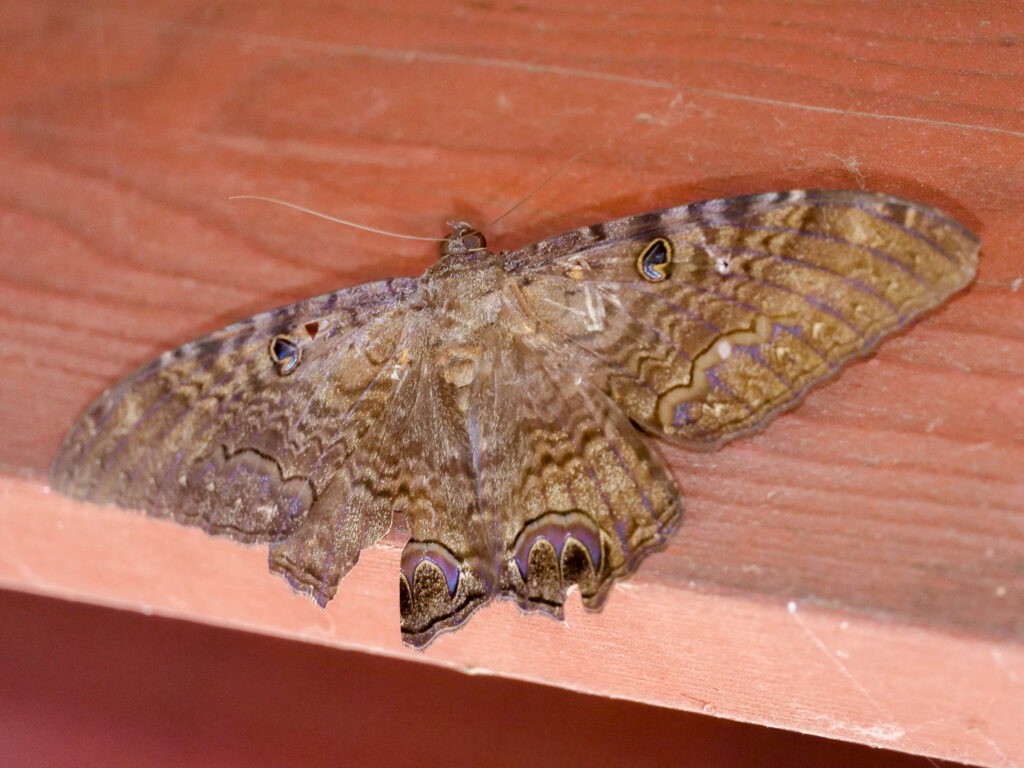
Ascalapha odorata makes its home in Mexico through Central America to much of South America. It’s a harmless moth that has generated fear across the Western Hemisphere as an omen of death, illness, witchcraft, and misfortune. Ethnographic studies show that this folklore dates back to the Aztecs, who called the moth micpapalotl or miquipapalotl, which literally means “death butterfly” or “death moth.” Another name, tetzahupapalotl, has been translated to “butterfly ot terror.” The moth was a portent of death; if someone was ill and it entered the home, the sick person would soon die.1
Karen Bassie-Sweet, an archaeologist specializing in Mayan traditions, argues that the Black Witch Moth was associated with supernatural transformation. Mayan warriors would sometimes adopt the moth as an avatar of Tlolac, one of the oldest and nearly universal figures in Mayan mythology. He was a rain deity and feared by believers, and adopting his imagery was associated with the dangerous boundary between life and death. As Bassie-Sweet put it: “When a Maya warrior took on the guise of this Lepidoptera, he was sending a powerful message to his foe. He was literally dressed to kill.”2
These connotations still exist in much of Mexico.
In South America, modern-day folklore carries similar meanings. In Ecuador, it’s known as tandacuchi, and it is viewed as a messenger of death when it enters a home.3
In parts of Colombia, it’s known as mariposa bruja, or “Witch’s Butterfly,” where it is described as a spy for witches — an allusion to its resting on building walls during the day — and is seen as a harbinger of tragedy.
A 2025 study from Miraflores, Colombia, looks at how people view the Black Witch Moth. A vast majority of people interviewed held negative feelings about the moth, with many saying it announced death, brought bad luck, or was associated with witches. Some of the quotes the author received from people in the region include:
“This butterfly attracts bad energies, and if it visits you, it announces death.”
“People in this region say they are ‘oidoras’ of the witches, who spy on people by clinging to the wall and listening to other people’s conversations.“
“If the butterfly is harmed or killed, its smile—and that of a child—will be extinguished.”
Another ethnoentomological study in central Colombia near Bogota asked people to react to the moth when attracted to a moth trap set up in the village.4
“I call it the witch butterfly. It makes me nervous, and people say it brings bad luck.”
“It disgusts me and means that something bad is going to happen.”
“It takes people’s souls away when it lands on the front door.”
These fears, however irrational, have consequences for the moth. A study in Quito, Ecuador, found that one-third of people admitted to killing the moth when they came across it, believing it is evil. Part of the reason appears to be that moth populations reach their peak in mid-to-late fall, coinciding with the celebration of the Day of the Dead.5
And that’s a shame. The Black Witch Moth is entirely harmless to humans, and, like many moths, is an important pollinator of night-blooming flowers. They are an important food source for small animals such as bats, birds, and lizards. They can fly huge distances, sometimes flying as far north as Canada from their home in Central America.
They aren’t always feared or despised. In some parts of its range, the larvae are a part of the cuisine. The larvae are a part of the cuisine in central Mexico, and in Chiapas, the larvae and adults are a part of the regional diet in some communities.6
In the Bahamas, encountering a Black Witch is said to bring money and good fortune rather than death. If it lands on a person, it’s said to symbolize new wealth. Even in Colombia, some see it as an omen of good fortune. One resident was quoted as saying, “The butterfly has a kind of number on its wings. By examining the wings, one can discover the numbers, and they can be used to play the lottery.”7
In Hawaii, the moth is said to symbolize the return of a deceased loved one to say a final farewell.8
If you are on Colorado’s Front Range, take a peek around outdoor lights this summer to see if the Black Witch Moth has visited you. It’s traveled thousands of miles, carrying centuries of folklore.
Photo Credit: By Charles J. Sharp – Own work, from Sharp Photography, sharpphotography, CC BY-SA 4.0, https://commons.wikimedia.org/w/index.php?curid=44799396
1. Carlos C. Hoffmann, “Las mariposas entre los antiguos mexicanos,” Anales del Museo Nacional de Arqueología, Historia y Etnografía 7 (1931): 422–425; reprinted in Etnobiología 10, suplemento 1 (2012): 44–46.
2. Karen Bassie-Sweet, “The Black Witch Moth as an Avatar of Tlaloc” (IMS Newsletter, May 2020)
3. Barragán, Álvaro R., Olivier Dangles, Rafael E. Cárdenas, and Giovanni Onore. “The History of Entomology in Ecuador.” Annales de la Société entomologique de France (Nouvelle Série) 45, no. 4 (2009): 410–423. https://doi.org/10.1080/00379271.2009.10697626
4. Calvo Rodríguez, Sara Catherina. De la etnoentomología al bioarte: Una propuesta intercultural para la concientización sobre Ascalapha odorata. Undergraduate thesis, Universidad Distrital Francisco José de Caldas, 2023.
5. Buitrón-Buitrón, Karina Paola, Kevin Alexander Toapanta-Amán, Cristina Monserrate Narváez-Valdivieso, and Wendy Betzabé Pacheco-Paredes. “Tandacuchis (Ascalapha odorata Linnaeus, 1758. Familia Noctuidae): Percepciones míticas y sociales en el Centro Histórico de Quito.” Ethnoscientia 6, no. 1 (2021). https://doi.org/10.22276/ethnoscientia.v6i1.336
6. Niño-Suárez, Mayra Alejandra, Camilo Alberto Marino-Valencia, David Camilo Romero-Martín, and Héctor Jaime Gasca-Álvarez. “Percepción sociocultural de la polilla bruja Ascalapha odorata (Linnaeus, 1758) (Lepidoptera: Erebidae) en Miraflores – Boyacá.” Boletín Científico Centro de Museos, Museo de Historia Natural, Universidad de Caldas 29, no. 2 (2025): 171–184. https://doi.org/10.17151/bccm.2025.29.2.8
7. Calvo Rodríguez, Sara Catherina. De la etnoentomología al bioarte: Una propuesta intercultural para la concientización sobre Ascalapha odorata. Undergraduate thesis, Universidad Distrital Francisco José de Caldas, 2023.
8. Niño-Suárez, Mayra Alejandra, Camilo Alberto Marino-Valencia, David Camilo Romero-Martín, and Héctor Jaime Gasca-Álvarez. “Percepción sociocultural de la polilla bruja Ascalapha odorata (Linnaeus, 1758) (Lepidoptera: Erebidae) en Miraflores – Boyacá.” Boletín Científico Centro de Museos, Museo de Historia Natural, Universidad de Caldas 29, no. 2 (2025): 171–184. https://doi.org/10.17151/bccm.2025.29.2.8
Like weird stories about bugs?
History, but with Bugs explores how insects have shaped our horror, folklore, history and popular culture.
Subscribe free on Substack or support the project on Patreon.
