

If you had walked into London’s Theatre Royal Haymarket on a cold December evening in 1860, expecting a harmless Christmas pantomime, you would have found yourself watching a war between aphids and ladybirds (the common name in the United Kingdom for ladybugs).
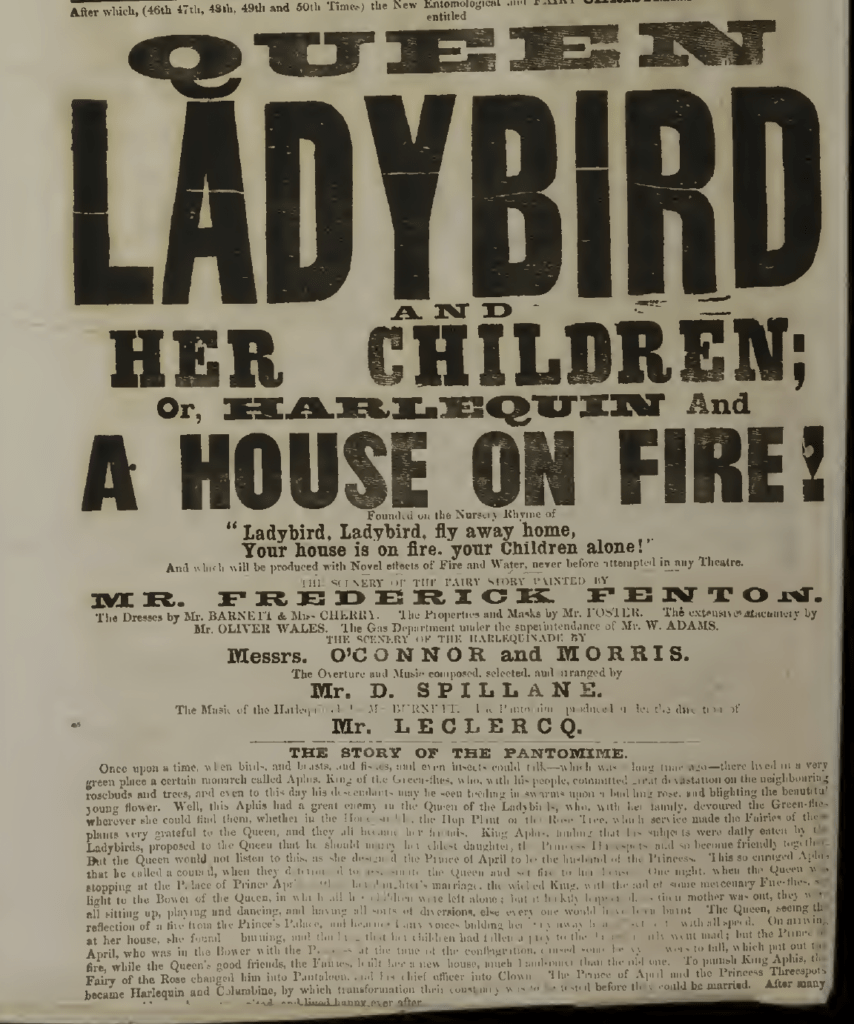
According to newspaper reviews at the time, you would have watched the curtain rise to see a gloomy throne room belonging to King Aphis, ruler of the greenflies (aphis and greenflies are older British terms for aphids). His children were being eaten by Queen Ladybird’s children, a nod to the natural history that plays out in gardens, forests, and prairies across the world.
He needed a solution to find peace for his kingdom, so he asked Queen Ladybird for her daughter’s hand in marriage. The queen rejected the king’s offer, and chaos ensued.1“The Christmas Pantomimes.” Evening Mail (London), December 28, 1860, p. 2.
The audience watched as young ladybirds jumped around their nursery and their beds, designed as seed pods, engaged in a pillow fight. Suddenly a voice offstage sang a warning: Ladybird, Ladybird, fly away home…
Queen Ladybird’s bower appeared to burst into flames as fireflies set fire to her home. The fireflies had been hired as mercenaries by the king. Critics of 1860 were astonished by the lighting tricks used to simulate the fire, noting that it was one of the most ambitious pantomime stage productions of the day.
The audience was then introduced to the story’s hero, Prince April. He summoned an April shower to douse the flames consuming the queen’s home. Again, critics were astonished that the production used real water for the April shower, stagehands having rigged up some elaborate pipes. Those pipes, however, froze on opening night, with stage manager John Buckstone rushing onstage to let the audience know what had happened. The audience laughed and took it in stride. 2“Haymarket.” The Globe (London, England), December 27, 1860, p. 4.
Prince April rushed onstage to save the day by summoning an April shower. Unlike most theatrical rainstorms of the period, this one was real. Water actually flowed across the set through hidden plumbing beneath the stage.
The water transformed the queen’s burned home into a glittering crystal kingdom with fountains and glass scenery.3“Christmas Entertainments.” Bell’s Weekly Messenger, December 31, 1859, p. 6. British Library Newspapers. Shelfmark BL_0001286_18601231_006.
Reviews across London were laudatory. London’s The Weekly Chronicle and Register wrote:4“Theatre Royal Haymarket.” The Weekly Chronicle and Register (London), December 29, 1860, p. 8.
It is, without exaggeration, a splendid spectacle, which everybody ought to see.
London’s Morning Advertiser wrote: 5“The Christmas Amusements.” The Morning Advertiser (London), December 27, 1860, p. 2.
There can be no doubt this elegant and fantastical production will become a great favourite with the frequenters of this theatre, who seem to look for prettiness and gaiety, rather than a more monstrous production, full of boisterous humour and stupendous effects. It was much applauded, and the author was duly honoured by a crowded and fashionable audience.
That pantomime, Queen Ladybird and Her Children, reveals something about how nineteenth-century audiences thought about ladybirds. They were an iconic part of folklore and nursery rhymes stretching back hundreds of years. The warning song mentioned earlier comes from the famous nursery rhyme:
Ladybird, Ladybird, fly away home
Your house is on fire, you children are gone.
This rhyme has persisted throughout much of Europe and coincides with several themes. Ladybirds are associated with the Virgin Mary (that’s where the “lady” in ladybugs, ladybirds, and lady beetles comes from). They were used to tell fortunes, for protection, and were symbols of good luck. Farmers knew their value centuries before their natural history was written down. For these reasons, audiences in 1860s Britain immediately understood what Queen Ladybird represented.
Victorian pantomimes were popular theatrical productions and a common source of family entertainment, with new shows often launching the day after Christmas. Despite the name, they were not silent performances. They combined fairy tales, nursery rhymes, topical jokes, music, dance, slapstick comedy, and audience participation. The term “pantomime” originated in earlier European traditions of mime and commedia dell’arte, but by the Victorian era, it had come to refer to a distinctly British form of entertainment. They often featured stock characters such as the mischievous Harlequin.
Queen Ladybird wasn’t the only version of ladybirds on stage. The earliest version I could find was the 1834 pantomime, The Demon of the Mystic Dart; or, Harlequin and the Ladybird Sprite.
The pantomime is explicitly said to be “founded on the nursery rhyme, commencing ‘Ladybird, ladybird, fly away home,’” and to feature a “Ladybird Sprite” alongside Harlequin.6“Pavilion: The Demon of the Mystic Dart; or, Harlequin and the Ladybird Sprite.” Old England (London), April 5, 1834, 112. There is little history of this pantomime preserved, but it’s clear that the ladybird is elevated from a tiny creature on a leaf to a “Ladybird Sprite,” a fairy presence important enough to share the title with Harlequin and to anchor the magical side of the action.
Another production, Ladybird; or, Harlequin Lord Dundreary (1862), pushed the symbolism even further.7“Westminster (Late Astley’s).” The Daily News (London), December 27, 1862, p. 6. British Library Newspapers, shelfmark BL_0000051_18621227_006. A selfish aristocrat tries to steal another man’s fiancée. Along the way, he casually attempts to flick a ladybird off the woman’s dress. She and her fiancé rush to protect the ladybird, and that puts the magic into motion. The ladybird was actually a fairy in disguise, and she sends an army of annoying insects — bees, gnats, beetles — to torment the aristocrat who will not leave the fiancé alone. The moral lesson is that protecting others is a virtue. Amassing wealth is not.
Yet another was Cinderella, Ladybird, Ladybird, Fly Away Home that had a run at Her Majesty’s Theatre in 1890. Again, the plot of the show was not well preserved in historical documents, but it’s clear the story is a riff off of the Cinderella fairy tale, and at least one source notes that the ladybird is the fairy godmother.8The Scots Observer: A Record and Review, no. 60 (January 11, 1890).
These early pop culture references to ladybirds as lucky, virtuous, and beloved continue to this day. Ladybirds are symbolized on lucky charms and jewelry, as luck symbols on postcards, on Sesame Street to teach children their numbers, and as a marketing tool for organic products and certifications. Tales of Miraculous Ladybug and Cat Noir is one of the most popular children’s shows in the world, and stars a girl who transforms into a ladybird in order to save the day. It continues a centuries-old tradition.
Most insects become villains in our popular culture, as symbols of disgust and fear (Think about The Fly or Arachnophobia). Ladybirds became royalty, helpers, and symbols of luck and protection. Why? To answer that question, we have to look to the history of how the ladybird got its name (stay tuned!).
This article is an excerpt from a chapter in my upcoming book, God’s Little Beast: A Cultural History of Lady Beetles.
Like weird stories about bugs?
History, but with Bugs explores how insects have shaped our horror, folklore, history and popular culture.
Subscribe free on Substack or support the project on Patreon.
