

That inspiration can be directly on the nose. Starship Troopers (novel 1959, film 1997) features alien enemies that are literally giant bugs. James Cameron and Paul Verhoeven brought to life a xenomorph with the exoskeleton, six limbs, and hive behavior that is starkly insect-like. The Formics or Buggers in Orson Scott Card’s Ender’s Game (novel 1985, film 2013) were inspired by ants. From the novel:
The buggers were organisms that could conceivably have evolved on Earth, if things had gone a different way a billion years ago… It was no accident that they looked insectlike to human beings… their physical structure still echoed their ancestors, who could easily have been very much like Earth’s ants.
These high-profile examples from film and literature offer convincing evidence of bug inspiration for aliens, and even mythology shows these influences. The gray alien of Area 51 or Roswell fame and the little green men folklore also point to insects. Think about what the pop culture images of their faces look like. Then think about a praying mantis face: starkly triangular head, large bug eyes, and a small or nonexistent mouth.
No research can make that connection artistically or symbolically. Is it a coincidence? Unknown. But the visual language is clear, and there’s some cultural history that might support that connection.
H. G. Wells’ First Men on the Moon (1901) brings two Englishmen to the moon where they encounter the Selenites, a species of alien with human-like and ant-like qualities. Wells’ character Cavor describes them:
I have already made it clear, I think, that the Selenites I saw resembled man in maintaining the erect attitude and in having four limbs, and I have compared the general appearance of their heads and the jointing of their limbs to that of insects.
Wells describes the Selenites as having castes similar to other social insects such as ants and bees. “The moon is, indeed, a sort of vast ant-hill.” Wells wrote.
This is the first bug-eyed alien in modern science fiction.
Wells’s Selenites were insectlike, but they weren’t particularly evil. The horror in the story comes more from humans’ inability to understand them and the disgust the main characters feel toward them. Wells flips that script, and it’s the humans that come off as not quite evil but very much hostile.
If Wells had made the aliens cat-like or wolf-like, the story would have been vastly different. The otherness of their appearance and the collectivity of their society cause human distrust and revulsion. Wolves and cats might get scary, but humans can understand and identify with four limbs, fur, and vertebrae. Compound eyes and jointed limbs become much more inhuman.
By the 1920s and 1930s, pulp science fiction exploded with creatures from outer space that had enormous eyes, antennae, claws, segmented limbs, and tentacles.
A classic example is the debut issue of Astounding Stories of Super-Science, published in January 1930. It featured H. W. Wesso’s illustration of an enormous beetle attacking a man for Victor Rousseau’s The Beetle Horde.
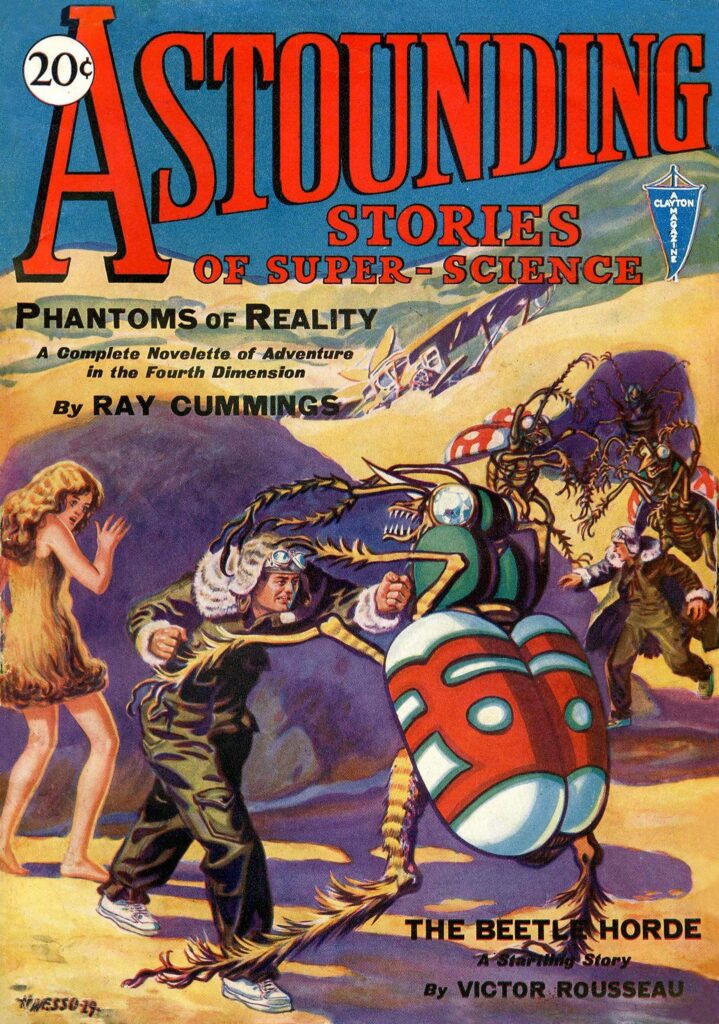
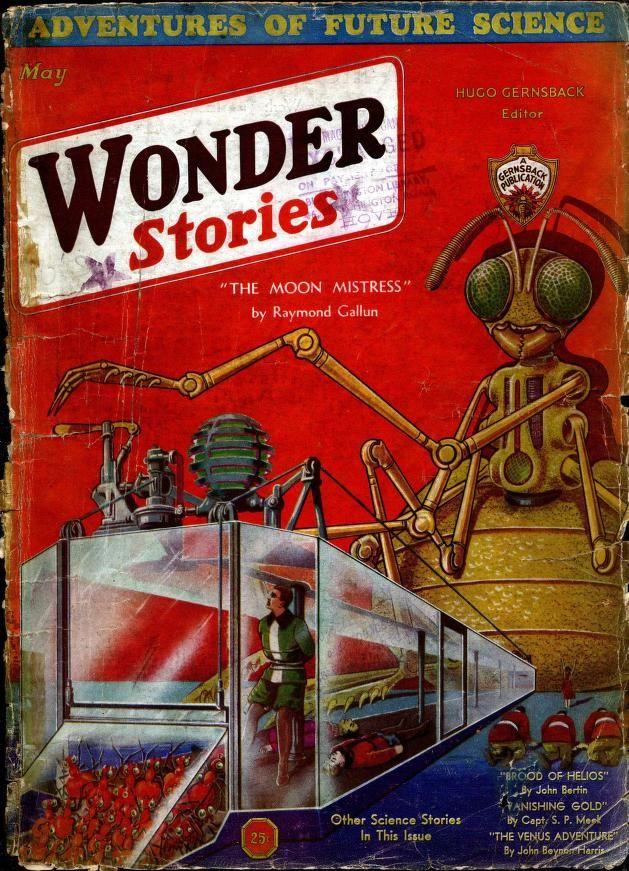
The following year, Wesso’s cover art depicted an alien with enormous eyes and spider-like limbs, with humans caught in a web. This then kickstarted a trend in science fiction illustration and storytelling with variations on aliens with big, insect-like eyes and every formulation of bug-like limbs and bodies.
The fandom of the 1930s pulp era was just as rabid as today’s, and the criticism and sarcasm were just as biting. Fans had many complaints, and one fan who didn’t like stapled pages, Wilson “Bob” Tucker, started the Society for the Prevention of Wire Staples in Science Fiction Magazines (SPWSSTFM). That started a war that rivals today’s shitposting. Another fan started the rival International and Allied Organizations for the Purpose of Upholding and Maintaining the Use of Metallic Fasteners in Scientific-Fiction Publications in the United States of America (IAOPUMUMSTFPUSA).
In August 1939, Thrilling Wonder Stories published a letter from Martin Alger complaining about its covers. He announced his new organization: Society For The Prevention Of Bug-Eyed Monsters On The Covers Of Science-Fiction Publications or SFTPOBEMOTCOSFP.[1]
That was the first published instance of “Bug-Eyed Monsters,” a descriptor still used today to talk about this feature of science fiction and horror.
And some people loved the Bug-Eyed Monsters. A letter from George M. Aylesworth in the October 1939 edition of Thrilling Wonder Stories clapped back: [2]
May I go so far as to give a lusty cheer; a loud, soul-stirring chant in defense of your covers? Hooray for Artist Brown!! Down with the SFTPOBEMOTCOSFP! ! I like bug-eyed monstrosities, on my stf. mags.; the farther out their orbs bulge, the better I like it! Paint ’em purple, green and yellow; with at least twenty-five slimy tentacles waving twenty-five. gleaming ray-guns. Oh! And I almost forgot, give ’em a beak and a mouth too.
By 1949, science fiction humorist Fredric Brown called extraterrestrials “BEMs” in his stories, [3] and in 1951 TIME listed “space ships” and “bug-eyed monsters” among tired science fiction clichés. [4]
The term “bug” in Bug-Eyed Monsters does a lot of work. Many were insectoid, but others had tentacles or scales reminiscent of reptiles or mollusks. But most forms had some arthropod qualities, which helped solidify insects as alien enough to stand in for actual aliens. And by 1959, humans were at war with these insect-like aliens.
Robert Heinlein doubled down on alien insects by making them distinctly insect. His Starship Troopers imagines an alien world inhabited by six-legged, hive-living creatures attacking Earth. The lack of individuality of the aliens in Starship Troopers contrasted drastically with the concepts of American individuality, capitalism, and the nuclear family.
That contrast, and the fascist undertones of Heinlein’s original, would inspire the satirical 1997 film of the same name by Paul Verhoeven. The visual effects lead for the film, Phil Tippett, gave an interview for the American Cinematographer, which gives a good example of the underlying discomfort that alien insects bring to the screen:
It’s interesting how the world is divided between people who are either terrified by insects or terrified by reptiles. I never was subject to the fear of reptiles, but insects always gave me the creeps. Making this film was no catharsis.
Large, compound, insect-like eyes of BEMs didn’t really carry through to the later part of the 20th Century, but insect forms absolutely did: Enter the xenomorph.
H. R. Giger’s creature in Ridley Scott’s Alien isn’t simply an insect. It reads as human, insect, machine, and reptile in ways that are deliberately hard to classify. But the “bug” is definitely there.
The xenomorph has mantis-like qualities, especially in the sequel, Aliens. Egg-laying conveys insect qualities, as does the creature’s need for parasitism. The creature’s exoskeleton is as mechanical as it is insect-like. The face-huggers definitely give “bug” vibes even as it’s largely unique in its strange qualities. The xenomorph also metamorphoses much like an insect.
It’s like a parasitic wasp that’s also a praying mantis. In Aliens, it now has a social structure with a queen. In fact, James Cameron’s first draft of the script for Aliens described it as uniquely insect-like:
A massive silhouette in the mist, the ALIEN QUEEN glowers over her eggs like a great, glistening black Insect-Buddha. What’s bigger and meaner than the Alien? His Momma. Her fanged head is an unimaginable horror. Her six limbs, the four arms, and two powerful legs, are folded grotesquely over her distended abdomen. The egg-filled abdomen swells and swells into a great pulsing tubular sac, suspended from a lattice of pipes and conduits by a web-like membrane as if some vast coil of intestines was draped carelessly among the machinery.
Other adjacent depictions include Predator with its mandible-like mouth, though the body is humanoid. Jean Jacket in Nope (2022) is more jellyfish than insect, but fits the “bug” characteristics tangentially. The creatures in A Quiet Place (2018) have exoskeletons and long limbs much like insects. The prawns in District 9 (2009) have bug eyes — well, more shrimp eyes, but shrimp are the bugs of the sea, right?
Obviously, not all alien horror depictions are bug-like. The Blob (1959, 1988) is just an amorphous blob. The visitors in Close Encounters of the Third Kind (1977) are humanoid. The Thing (1982) has no shape except for what it replaces.
When we think about how life on other worlds might evolve, it’s not a stretch to imagine bug-like creatures. After all, insects are by far the most common animals on Earth. Isaac Arthur, an author and futurist with expertise in science fiction, lays out the nature and science behind these trends in his video, “Insectoid Aliens – Hive Minds, Swarms, and Alien Evolution”:
We tend to think of aliens as little green men, but if we’re taking our cues from nature, it’s far more likely they’ll be little green beetles — or at least something with an exoskeleton, jointed legs, and a remarkable ability to survive nearly anywhere. Insects are Earth’s true masters, found in every climate from frozen tundra to the hottest deserts, and often in swarms that can reshape entire ecosystems. That makes them an obvious candidate when we imagine alien life in fiction.
Insects are alien to many of us, and they appear in stories and on screen because they tell us something about what it is to be human by contrasting with very non-human parts and behaviors. They wouldn’t have the same meaning or impact if aliens were shaped like cats, dogs, or cows. Humans have a natural affinity for creatures closer to us on the evolutionary tree. That’s not to say a rabid dog, a mountain lion on the hunt, or a stampede of cows aren’t frightening. But we have empathy for these warm-blooded, fur-covered vertebrates. For insects, we don’t. That’s what makes them scary as vehicles for extraterrestrial horror.
- Martin Alger, letter to the editor, “The Reader Speaks,” Thrilling Wonder Stories 14, no. 1 (August 1939): 121, Internet Archive.
- G. M. Aylesworth, letter to the editor, “The Reader Speaks,” Thrilling Wonder Stories 14, no. 2 (October 1939): 122, Internet Archive, page image.
- Fredric Brown, “All Good BEMs,” Thrilling Wonder Stories 34, no. 1 (April 1949): 124–25, Internet Archive, page image
- “Books: Sensible SF?” TIME, June 11, 1951, TIME archive
Like weird stories about bugs?
History, but with Bugs explores how insects have shaped our horror, folklore, history and popular culture.
Subscribe free on Substack or support the project on Patreon.
