

On June 7, 2000, Survivor: Borneo became the first American reality television show to disgust viewers and contestants with bugs. The second episode’s immunity challenge tempted each tribe with immunity if each member ate a palm-weevil larva known locally as butod. The larvae are big, about 2 inches long and half an inch wide.

Surprisingly, every member of both tribes ate the butod, forcing a tie. The tribes were asked to pick someone from the other tribe who would have the most trouble eating the Butod. In the end, Gervase Peterson was bested by Stacey Stillman, giving the Tagi tribe immunity from elimination.
The problematic nature of the episode was the exploitation of a common food in Malaysian Borneo for shock value on American television. Western notions of entomophagy, or the practice of eating insects for either sustenance or pleasure, are pretty rigid. Western cultures tend not to use insects in cuisine, while much of the rest of the world does.
That episode of Survivor kicked off another 30-plus years of reality television exploiting fear and disgust of insects for ratings and profit. The next year, 2001, Fear Factor debuted with humans trapped in containers and covered with insects as a staple challenge. The following year Britain’s I’m a Celebrity…Get Me Out of Here! incorporated similar tactics. Reality shows like Big Brother, The Challenge, and The Traitors are among those that have used either eating bugs or covering humans in bugs for shock value.
Even America’s Next Top Model featured an episode in season 6 where contestants had to walk the runway with insects as living jewelry. One contestant refused to do so and was eliminated. Another kissed her Madagascar hissing cockroach at the end of the runway and won the episode.
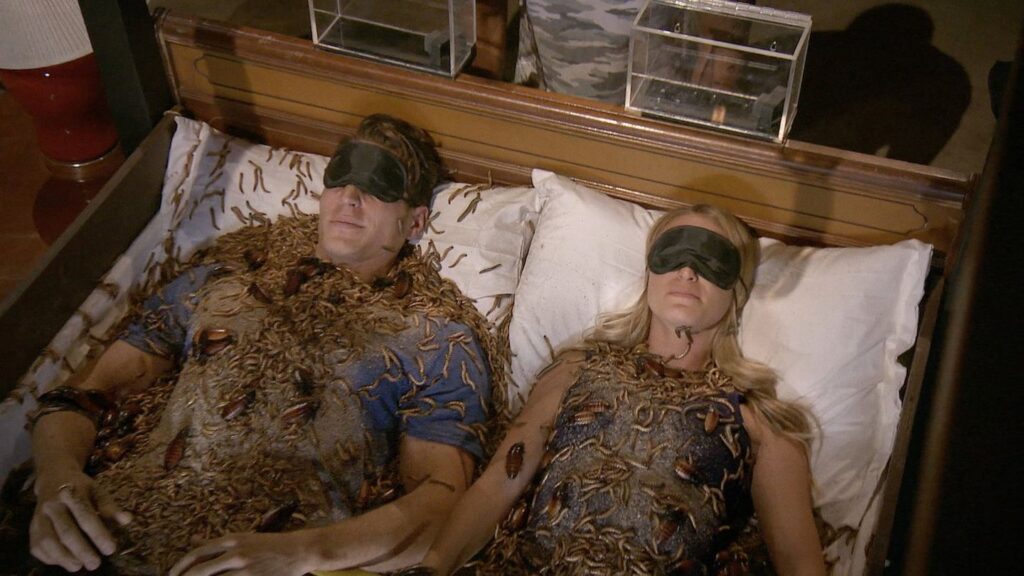
Why have bugs become a common shock value of reality TV? There are other ways to shock audiences: other creatures like snakes, more dangerous stunts, harder to solve puzzles.
Bugs provide an intense emotional response from contestants and the audience without creating any genuine danger. And they are cheap and harmless. Covering a contestant in crickets or mealworms cost very little in terms of production costs or in terms of risks for the contestants. But it has a big emotional and ratings payoff. The same goes for challenges that require eating those bugs.
Both the audience and the contestants are responding to a couple of emotional cues. Disgust is a common one when it comes to insects. Especially when it comes to entomophagy.
Media theorist Scott Wilson analyzed Fear Factor’s typical second challenge that often involved either eating or being smothered by bugs.[1] He theorized that Fear Factor used abjection as both entertainment for the audience and discipline for the contestants. Abjection means the disgust and revulsion of things perceived as being contaminating or cultural boundary-crossing. Bugs are very useful in this format, especially in Western cultures. They turn into tests of character for the contestants who are humiliated for the benefit of the viewing audience who derive pleasure not only from watching someone be humiliated, but also from the triumph over that humiliation.
Psychologist Paul Rozin and researcher Matthew Ruby have shown that disgust is not a simple response to an animal’s actual danger. [2] In their studies, participants distinguished between animals they found unpleasant and animals they found disgusting to eat. Butterflies, for example, were generally viewed positively and considered beautiful, yet participants still found the idea of eating them deeply disgusting.The researchers looked at both eating various animals, but also contagion. When a beloved animal (such as butterfly, dog, or canary) touched food, most respondents didn’t see contagion as an issue. But when animals such as vultures, cockroaches or hyenas touched food, there was a strong disgust reaction. The researchers hypothesized that contagion was the key factor in eliciting disgust.
That theory is backed up by the work of Amanda Lorenz, Julie Libarkin, and Gabriel Ording who found that disgust responses toward some bugs overlap with disgust responses associated with pathogens. [3] They go further and explain the implications of this. As society becomes more heightened to the risks of pathogens, people are responding more emotionally to bugs than previous generations. And that means people are less likely to be in favor of insect conservation.
We’re at a moment where insects are experiencing a mass extinction event, and conservationists (like me!) are trying to convince people that insects are a vital part of ecosystems and our food supply. That they are an inherently good part of our world.
But popular culture in general, and reality shows in particular are helping to undermine those educational efforts. And so is our geography.
Research by Yuya Fukano and Masashi Soga suggests that modern urban lifestyles may actually intensify disgust of bugs. [4] Living in a city means people encounter fewer insects in natural environments. They don’t learn about the diversity and usefulness of arthropods. Instead, they mostly encounter them indoors where insects often signal sanitation problems. For many people, their only contact and context for insects, spiders, and other arthropods is profoundly negative. And reality TV shows reinforce and exploit that.
What we don’t see from Survivor is the cultural importance of these insects as a form of sustenance and cuisine in the parts of the world the contestants have been assigned. What we don’t see from Fear Factor is a respect for the animals used to humiliate contestants. And of course we don’t. It would diminish the suspense and drama of those moments.
But it also reinforces a message that bugs are bad, disgusting, and their inherent worth is limited. That’s not a good thing when the world needs to pay attention to a massive decline in these important animals.
And before anybody comes for me: I’ve watched every episode of Survivor, both American and Australian versions. I love the show, just not its early treatments of insects and culture. I’m looking forward to the premiere of Survivor 51: The Open Era on September 23!
Sources
2. Rozin, Paul, and Matthew B. Ruby. “Bugs Are Blech, Butterflies Are Beautiful, but Both Are Bad to Bite: Admired Animals Are Disgusting to Eat but Are Themselves Neither Disgusting nor Contaminating.” Emotion 20, no. 5 (2020): 854–865. https://doi.org/10.1037/emo0000587.
3. Lorenz, Amanda R., Julie C. Libarkin, and Gabriel J. Ording. “Disgust in Response to Some Arthropods Aligns with Disgust Provoked by Pathogens.” Global Ecology and Conservation 2 (2014): 248–254. https://doi.org/10.1016/j.gecco.2014.09.012.
4. Fukano, Yuya, and Masashi Soga. “Why Do So Many Modern People Hate Insects? The Urbanization–Disgust Hypothesis.” Science of the Total Environment 777 (2021): 146229. https://doi.org/10.1016/j.scitotenv.2021.146229.
1. Wilson, Scott. “Blowing Chunks: Fear Factor, Reality Television and Abjection as a Disciplinary Practice.” Continuum: Journal of Media & Cultural Studies 24, no. 5 (2010): 751–761. https://doi.org/10.1080/10304312.2010.510592.
